
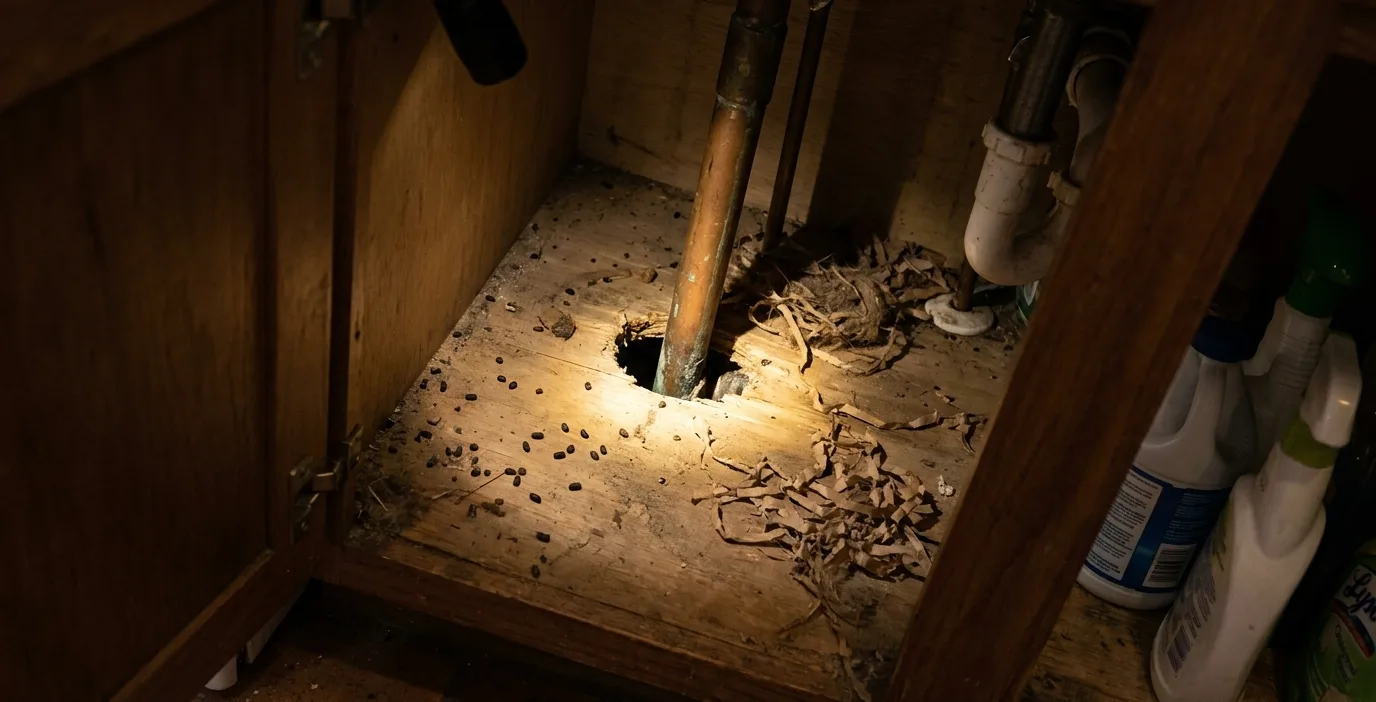
It is the first week of January. In homes across Squirrel Hill, Lawrenceville, Brookline, Mt. Lebanon and Penn Hills, someone carries the ornament boxes back down to the basement. The cardboard feels soft at one corner. Inside, there is shredded tissue paper and a scatter of tiny black droppings. Mice in winter are not a fluke in Pittsburgh. They are the normal pattern.
Here is what most people miss. Those mice did not show up on New Year’s Day. Most moved in back in October or November, when the first hard frosts hit. The holidays just made you open the boxes, the pantry and the guest room closet. That is when the evidence came out.
So what now? Are there a few mice or a whole family? Will they leave when it warms up?
This guide answers all of it. You will learn why mice come inside, how fast they multiply and what to do this week. We also include a Pittsburgh month by month table for October through March.
Quick Answer
Mice in winter come inside for warmth, food and shelter. In Pittsburgh, most enter between October and December, as nights drop toward freezing. You often find them after the holidays because that is when you open storage, cook more and move boxes.
House mice do not hibernate. They stay active all winter in your walls, basement, attic and storage areas. They breed indoors too. A female house mouse can have a new litter roughly every month in good conditions. Her young can breed within about two months. That is why a small problem in November can become a large one by March.
Holiday storage is a favorite spot. Cardboard, tissue paper and tree skirts make soft nest material. Boxes in a quiet basement corner sit untouched for eleven months.
Your plan has four steps. Confirm where mice are active. Set snap traps along walls near the signs. Clean droppings with a bleach solution, never by sweeping. Then seal the gaps where mice get in. Trapping alone will not end it.
If you keep finding fresh droppings after a week of trapping, call Rodent Shield Pittsburgh. We find the entry points and seal them with steel mesh, hardware cloth and metal.
Why Do Mice Come Inside in Winter?
Mice come inside in winter because they need warmth, steady food and a dry place to nest. Outdoor food gets scarce once frost kills plants and seeds. Your house offers heat from the furnace, crumbs in the kitchen and quiet storage spaces. A gap about the size of a dime is enough for a mouse to get in.
Mice follow warm air leaking from a dryer vent, a utility line or the sill plate. Once inside, they stay near the stove, fridge, water heater and furnace. In older Pittsburgh houses, they also climb inside hollow walls from basement to attic.
What Time of Year Do Mice Enter Houses in Pittsburgh?
In Pittsburgh, mice usually enter houses from late September through December. The push begins when nights first dip into the 30s. It peaks around the first hard freezes. Some mice keep moving in all winter during cold snaps. In early spring, activity rises again as full nests spread out into new rooms.
Fall is the best time to stop them. Our fall rodent proofing checklist walks you through it. Missed that window? Act now, because the longer mice stay, the more they breed. For a full year view, see our Pittsburgh rodent seasonal calendar.
How Quickly Can Mice Infest a House?
Mice can infest a house within a few months. House mice mature fast, often breeding at around six to eight weeks old. A female can have several litters a year, usually with five or six pups each. Two mice that slip inside in October can become dozens by early spring.
Indoors, mice face no winter slowdown. Breeding keeps going through December, January and February. Acting in early winter usually takes fewer visits than acting in March.
One mouse sighting in daylight often means several more are hiding nearby.
Why Do You Find Mice After the Holidays?
You find mice after the holidays because the season changes your routine. You open storage that sat closed all year. You bake more, host guests and leave food out. Doors open more often for deliveries and visitors. All of this exposes mice that moved in quietly back in the fall.
Gift baskets, candy and firewood by the back door add even more food and cover.
If You Hear Scratching Only at Night
Mice are most active after dark, moving between nest and food. Our guide on scratching in walls at night helps you tell mice from pipes.
If Droppings Are Only in the Decoration Bins
The nest may be in the storage area itself. Check every box nearby, not just the one you opened.
If Mice Show Up Right After a Cold Snap
A sudden freeze pushes more mice indoors. That points to an open gap at the foundation, sill plate or garage door.
Do Mice Nest in Christmas Decorations Storage?
Yes, mice often nest in Christmas decorations storage. Cardboard boxes, tissue paper, tree skirts, stockings and artificial garlands make ideal nest material. Bins in basements, attics and garages sit undisturbed for most of the year. Mice chew through cardboard easily. They shred soft items to build warm nests close to your heat.
Mice in Christmas decorations storage leave chewed box corners, droppings on lids and shredded paper. Throw away any light set with chewed, exposed wire. Then store decorations this way.
- Use hard plastic bins with tight lids, not cardboard.
- Never store food gifts, candy or scented pinecones with decorations.
- Shake out wreaths, garlands and tree skirts before packing.
- Keep bins on shelves, off the floor and away from walls.
- Check bins for droppings before you bring them upstairs next year.
Which Mice Get Into Pittsburgh Homes in Winter?
The house mouse is the most common winter intruder in Pittsburgh homes. On wooded and hillside lots, deer mice and white-footed mice also come inside. They favor garages, sheds and cabins. Telling them apart matters, because deer mice and white-footed mice can carry hantavirus. That changes how carefully you should clean.
| Feature | House mouse | Deer mouse | White-footed mouse |
|---|---|---|---|
| Color | Gray brown, lighter belly | Brown top, white belly, sharp line | Brown top, white belly, softer line |
| Tail | Long, nearly hairless | Two-toned, clearly bicolored | Two-toned, less sharp |
| Where in Pittsburgh | City row houses and suburbs | Wooded edges, rural lots | Wooded suburbs, hillsides |
| Favorite winter spots | Kitchens, walls, basements | Garages, sheds, cabins | Garages, attics, storage |
| Hantavirus host | Not a main host | Yes | Yes |
Learn more on our house mouse and deer mouse pages. If you suspect deer mice, read our hantavirus guide for Pennsylvania before you clean.
Where Do Mice Get In on Older Pittsburgh Homes?
In older Pittsburgh homes, mice get in through stone foundations, the sill plate and utility lines. Garage doors and dryer vents are common too. Row houses add shared walls and shared basements. Freeze and thaw cycles can open old mortar joints over the winter. Any gap about a quarter inch wide can let a mouse inside.
Check these spots first.
- Cracked mortar in stone or block foundations
- Gaps where gas, water and cable lines enter
- Old coal chutes and basement windows
- Worn garage door seals and open dryer vents
- Weep holes in brick veneer on newer suburban homes
Our post on freeze-thaw rodent entry explains why stone foundations open up. For basements, see our basement and crawl space rodent control service.
What Should You Do Right After You Find Mice?
Right after you find mice, protect your food, set snap traps, clean droppings safely and look for entry points. Do it the same day. Most homeowners can do the first round in two to three hours. Then check traps daily for one to two weeks. If mice keep showing up, the entry point is still open.
- Seal up food (30 minutes). Move flour, cereal, nuts, candy and pet food into glass, metal or hard plastic containers.
- Set snap traps (30 minutes). Place them along walls every few feet, trigger side toward the wall. Use a small dab of peanut butter.
- Clean droppings safely (45 to 60 minutes). Air out the area, wear gloves and use a bleach solution. Never sweep or vacuum.
- Repack storage (1 hour). Move decorations into lidded plastic bins. Throw out chewed cardboard.
- Find entry points (1 to 2 hours). Use a flashlight along the foundation, pipes and sill plate inside and out.
- Seal small gaps (1 to 3 hours). Pack gaps with steel wool or copper mesh. Cover larger openings with hardware cloth.
- Check traps daily (5 minutes a day, 1 to 2 weeks). Reset traps and note where catches happen.
Skip loose poison indoors. Poisoned mice can die in walls and cause odors.
How Do You Clean Droppings in Holiday Storage Safely?
First, air out the space for 30 minutes. Then wear gloves and spray droppings with a bleach solution. The CDC advises one and a half cups of bleach per gallon of water. Let it soak five minutes, wipe it up with paper towels, and bag it. Never sweep or vacuum droppings, since that can stir up particles.
Follow the CDC guide to cleaning up after rodents for the full steps. Spray nests and soiled boxes the same way before you throw them out. The CDC also has a broader page on controlling wild rodent infestations.
Large messes are a different job. If droppings cover insulation, a crawl space or a whole storage room, our rodent droppings cleanup service handles it.
What Does Winter Mouse Control Cost in Pittsburgh?
Typical Pittsburgh area ranges run about $150 to $350 for a basic trapping visit. Sealing and exclusion often adds $200 to $600 for a typical house. Droppings and nest cleanup usually runs $200 to $700. An inspection on its own is often $100 to $200. Your price depends on the home, the gaps and how long mice have been there.
These are general ranges, not quotes. See our rodent control cost in Pittsburgh page for more detail.
What Happens With Mice Month by Month From October to March?
From October to March, Pittsburgh mice move in, settle down, breed and then spread out. October and November bring the biggest push indoors. December through February is the settled, breeding season inside walls and storage. March brings thaw, full nests and more visible activity. Each month calls for a slightly different step.
| Month | Pittsburgh weather pattern | What mice do | What you should do |
|---|---|---|---|
| October | First frosts, cool nights | Scout foundations and slip in through gaps | Seal gaps, clear yard clutter |
| November | Nights near freezing | Major push indoors, nest building | Set traps, check basements and attics |
| December | Cold, early snow, holidays | Settle near heat and food, keep breeding | Store food tight, check decoration bins |
| January | Coldest stretch, freeze and thaw swings | Active in walls, litters grow | Trap hard, clean droppings, find entry points |
| February | Cold with thaws | Population at its winter high | Seal openings, book an inspection if needed |
| March | Thaw, rain, warming days | Spread out, some move to sheds and yards | Recheck seals, clean storage areas |
When spring arrives, read our guide on mice after winter. It covers what to clean and check once the cold breaks.
Will Mice in Winter Leave on Their Own in Spring?
No, mice in winter rarely leave on their own in spring. A warm, food-rich home is better than any spot outside. Some may wander out as the weather warms, but nests, young mice and the open entry points stay behind. Without sealing, new mice can follow the same path back in next fall.
Waiting for warm weather only lets droppings build up in insulation and storage.
Why Do Winter Mice Keep Coming Back After Trapping?
Winter mice keep coming back because the entry points are still open. Traps catch the mice already inside, but new ones keep following warm air into the house. Other common causes are traps in the wrong spot, food left out and a neighbor’s shared wall. Sealing the gaps is what ends the cycle.
Use this troubleshooting list.
- Traps catch nothing, but droppings keep appearing. Move traps flush against the wall near the droppings.
- Traps catch a mouse every few days for weeks. An entry point is open. Check the sill plate and utility lines.
- Mice return after you sealed. Look higher. Gaps near the roofline and attic vents get missed.
- You live in a row house. Mice may come through a shared basement or party wall.
Foam alone also fails, because mice chew through it. Pack gaps with steel wool or copper mesh first.
Why Pittsburgh Homeowners Choose Rodent Shield Pittsburgh
At Rodent Shield Pittsburgh, we focus on rats and mice. That is all we do. We know brick row houses in Bloomfield and the South Side. We know stone foundations in the East End and newer builds in Cranberry Township.
We begin with a full rodent inspection, basement to attic. We trap the mice already inside. Then we seal entry points with steel mesh, hardware cloth and metal flashing, not foam alone. We clean droppings and nests the safe way, and we explain what we fixed in plain words.
We serve homes across the city and Allegheny County, including Squirrel Hill, Lawrenceville and Mt. Lebanon. Same day visits are often available in winter.
Frequently Asked Questions
Do mice hibernate in winter?
No, mice do not hibernate in winter. House mice stay active all season. Indoors, they keep eating, nesting and breeding as long as they have heat and food. That is why winter is often when Pittsburgh homeowners notice the most activity in walls and basements. Mice outside may slow down during the coldest nights, but they do not sleep through the season. Instead, many of them look for warm buildings. Your basement, attic, garage and storage rooms are exactly the shelter they want from the cold.
Are mice worse in winter or summer?
Mice are usually worse indoors in winter. In summer, mice have plenty of food and shelter outside, so fewer of them try to get into homes. Once cold weather arrives in October and November, they move toward warm buildings. In Pittsburgh, that means indoor activity tends to climb through fall and stay high until spring. Summer problems do happen. They are more often tied to open doors, garages, sheds or a gap that was never sealed. Winter is when the indoor pressure is strongest across the region.
Why do I only get mice in winter?
You likely only notice mice in winter because that is when they need your home most. During warm months, mice live outside in yards, woods and fields. Cold weather pushes them toward the warm air leaking from your foundation, vents and sill plate. If you see mice every winter, it usually means the same entry point stays open each year. Find and seal that gap in early fall, and the yearly cycle usually stops. A fall inspection is the best way to find gaps you cannot spot alone.
How do I know if mice are in my Christmas decorations?
Look for chewed corners on cardboard boxes, droppings on lids and shredded tissue paper inside. You may also smell a musky, stale odor when you open the bin. Fabric items like tree skirts and stockings may have small chewed holes. Check light strings for chewed wire coating, and throw out any set with exposed wire. If you find a nest, spray it with a bleach solution before removing it. Then check every other box stored nearby, because mice rarely stay in only one container in a storage area.
Can mice get into plastic storage bins?
Mice can chew through thin, soft plastic if they have a reason to. Sturdy bins with tight lids work well in most homes. The bigger risk is a bin with a cracked lid, a missing latch or a gap at one corner. Keep bins off the floor and away from walls, since mice travel along edges. Never store food, candy or scented items in the same bins as decorations. Those smells give mice a strong reason to chew. Check the bins each season and replace any that are cracked.
How many mice are there if I see one?
If you see one mouse, there are usually more nearby. Mice live in family groups and breed quickly once they are warm and fed indoors. Seeing a mouse in daylight can be a sign that the nest is crowded or food is scarce. To judge, look for droppings in more than one room. Also watch for fresh droppings after you clean and noise on more than one floor. Any of those signs points to a larger group. Trapping for a week will also show you how many are active.
Should I use poison for mice in winter?
We do not suggest loose poison inside the house. Mice that eat bait can die inside walls, ceilings or under floors. That can cause a strong odor for weeks. Poison is also a risk for children, dogs and cats. Snap traps placed along walls work well indoors and let you confirm each catch. Outdoor bait stations can have a place in a full plan. They should be tamper resistant and placed with care. Pair any trapping or baiting with sealing the entry points, or mice will keep coming in.
Do mice come in with firewood?
Mice can hide in firewood stacks, and bringing wood inside can give them a ride in. More often, a woodpile by the house gives mice cover while they hunt for a foundation gap. Keep firewood stacked at least a few feet from the house and off the ground. Bring in only what you will burn in a day or two. Shake each piece and check the rack before carrying it inside. Look at the base of the wall behind the stack for droppings or gnaw marks.
Can mice chew holiday lights and wires?
Yes, mice can chew holiday lights and wires. Their teeth never stop growing, so they gnaw on almost anything, including wire coating. Chewed lights stored in a basement or attic can be a fire risk once you plug them in. Before you use stored lights, check the full length of each strand for bare wire, nicks and droppings. Throw away any damaged set. Store lights in lidded plastic bins, not cardboard. Inside your walls, chewed wiring is a reason to call an electrician as well as us.
Are deer mice in my garage dangerous?
Deer mice and white-footed mice can carry hantavirus, so they deserve more care than house mice. The risk comes mostly from breathing in particles from dried droppings, urine and nests. That is why you should never sweep or vacuum droppings in a garage, shed or cabin. Air the space out for 30 minutes first. Wear gloves and spray droppings with a bleach solution before wiping them up. If the mess is large or in a closed space, have a professional handle the cleanup.
How long does it take to get rid of mice in winter?
Most winter mouse problems take one to three weeks to clear. That assumes traps are set and entry points are sealed. Small problems found early can end in a few days. Larger infestations in older homes with many gaps can take longer, especially if mice live inside walls. The biggest factor is sealing. If you only trap, new mice keep coming in and the problem can drag on all season. Once gaps are closed and traps stay empty for a week, you are usually set until next fall.
Should I throw away boxes with mouse droppings?
Yes, throw away cardboard boxes with mouse droppings, nests or urine stains. Cardboard soaks up urine and is hard to clean. Before you move the box, air out the space and wear gloves. Spray the box and droppings with a bleach solution and let it soak for five minutes. Then place the box in a plastic bag, seal it and put it in your outdoor trash. Clean any hard decorations from the box with the same solution. Wash fabric items in hot water before you pack them again.
Next Steps
Mice in winter are a normal Pittsburgh problem, but they do not have to stay. Here is what to do now.
- Check your storage today. Open every decoration bin and box in the basement, attic and garage.
- Protect food. Move pantry staples and pet food into sealed containers.
- Trap this week. Set snap traps along walls where you see droppings.
- Clean safely. Use the bleach method, never a broom or vacuum.
- Seal the gaps. Close entry points with steel wool, copper mesh and hardware cloth.
- Get help if mice return. Call Rodent Shield Pittsburgh for mice removal in Pittsburgh and rodent proofing and exclusion.
Then plan to seal again in September, before next winter’s mice arrive.
Need Rodent Control in Pittsburgh?
Call Rodent Shield Pittsburgh at (412) 560-9090 for same day rat and mouse removal, sealing and cleanup across Pittsburgh and Allegheny County.